
-
SnapOS
-
-
- Articles coming soon
-
-
-
- Citrix HDX + USB Headset (Call-Center Baseline)
- OS/Firmware Update & Rollback
- Power Management and Session State
- Wi-Fi Roaming & Link Change Mid-Session
- Kiosk / Assigned-Access Auto-Launch
- Barcode Scanner (HID) with Line-of-Business App
- Printing to Local USB & Network Printers
- USB Device Management – Block Storage
- Multi-Monitor & 4K Performance
- Microsoft AVD/RDP + Teams Optimized Video
- VMware Horizon + Smart Card / CAC Login
-
-
-
-
zWAN
-
-
-
-
- Firewall & Layer 7 Application Filtering
- VPN Site-to-Site Tunnel Setup & Connectivity (z40 to Cloud vGR)
- Intrusion Prevention System (IPS) / Intrusion Detection System (IDS) Testing
- DNS Filtering
- DDoS Protection & Logging
- MAC Address Filtering & Geo-fencing
- Application Control & Protocol Blocking
- Authentication & Access Control (zID)
-
- WAN Link Failover & Load Balancing (ACI Mode)
- Dynamic Path Selection & Application-Aware Routing
- SaaS & Internet Breakout Validation
- QoS for Microsoft Teams (Datacenter vGR + Branch z40)
- Tunnel Failover (z40 ↔ vGR) — WAN00 (wired) primary, WAN03 (4G) & WAN04 (5G) backups
- IP Routing & Static Route Steering (z40 Branch)
- VLAN & Layer-2 Bridging
-
-
-
-
-
-
- Articles coming soon
-
-
-
-
- Articles coming soon
-
- Articles coming soon
-
-
-
-
-
-
- Articles coming soon
-
- Articles coming soon
-
- Articles coming soon
-
- Articles coming soon
-
-
-
-
-
- Articles coming soon
-
- Articles coming soon
-
- Articles coming soon
-
- Articles coming soon
-
-
-
-
-
- Articles coming soon
-
- Articles coming soon
-
- Articles coming soon
-
- Articles coming soon
-
-
- Articles coming soon
-
- IPsec Tunnel not Establishing
- SSL-VPN Tunnel not Establishing
- Mobile Network Issues
- Management Tunnel does not Establish
- DNS not Resolving from Local Network Appliance
- DNS Resolution Issues in Tunnel Configuration
- DHCP Server not Leasing IP to LAN PC
- Debugging EC Events - Unknown Status Issue
- Trusted-MAC Geofencing Issues
- DNS Issues from DC LAN PC
- Troubleshooting LAN Connectivity to Internet via WAN, Remote Branch LAN, or Local Branch LAN
- NetBalancer gateways displaying Faulty/Inactive
- Packet Drop Issues
-
-
zAccess
-
StorTrends
Access Point Mode (AP Mode)
Overview
zWAN stack creates Wi-Fi AP mode interface WLANXX for every supported Wi-Fi hardware device {phyX/wlanX} enumerated in startup. It exposes EC's LAN network functionality to wireless so that clients/workstations could connect to it and form a wireless LAN in adjacent to wired LAN.
On supported hardware, Wi-Fi AP mode is enabled by default with an uniqueue SSID and password for security, password is same as SSID.
Multiple SSID
The zWAN stack creates multiple SSID interfaces using WLANXX for every supported Wi-Fi hardware device (phyX/wlanX) enumerated at startup. This functionality exposes the WLANXX interface for the creation of multiple Access Points (APs), allowing clients and workstations to connect to multiple APs through a single interface.
On supported hardware, We need to enable the Multiple SSID and set the unique SSID and password for security.
Wi-Fi AP MODE & Multiple SSID SUPPORTED FUNCTIONALITY
- Configure Wi-Fi Acces Point Interface
- Enable Wi-Fi Acces Point service
- Disable Wi-Fi Acces Point service
- Edit Wi-Fi Acces Point Interface Configuration
- List Wi-Fi Acces Point Interface Configuration
- Delete Wi-Fi Access Point Interface Configuration
Wi-fi Functionality can be managed via Provider , LocalWebUI and secureshell
CONFIGURE Wi-Fi AP MODE
- WITH PASSWORD
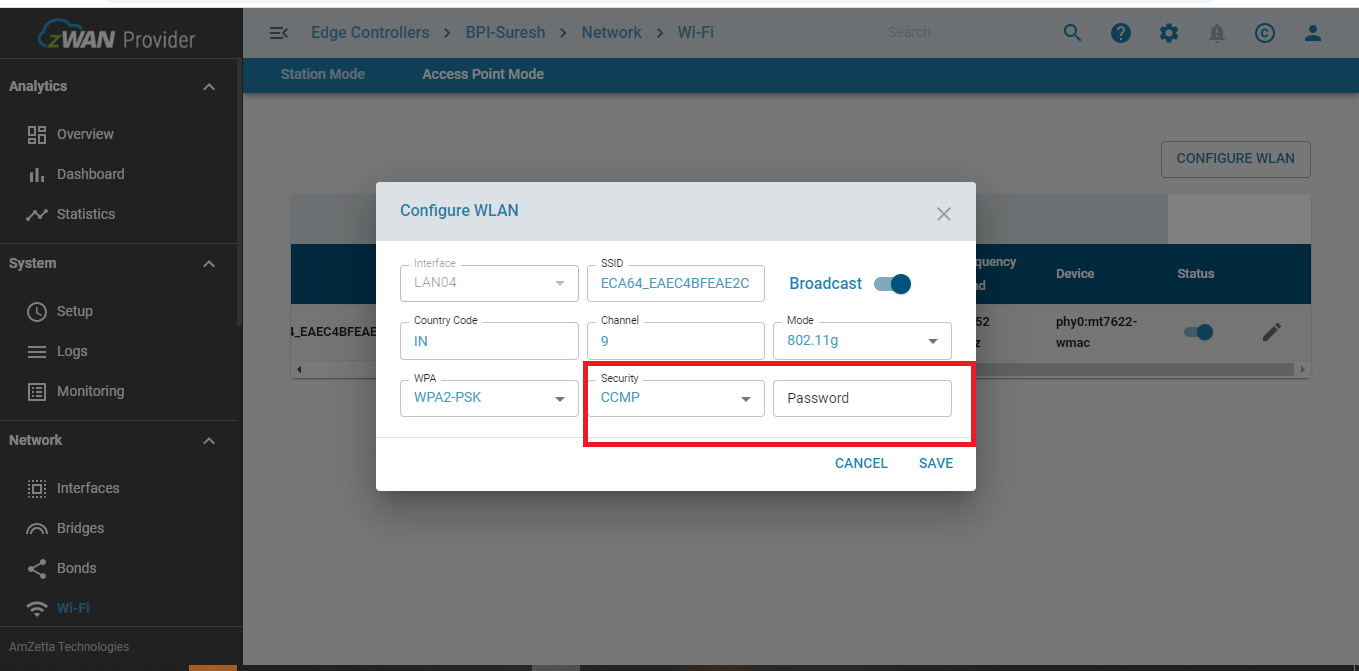
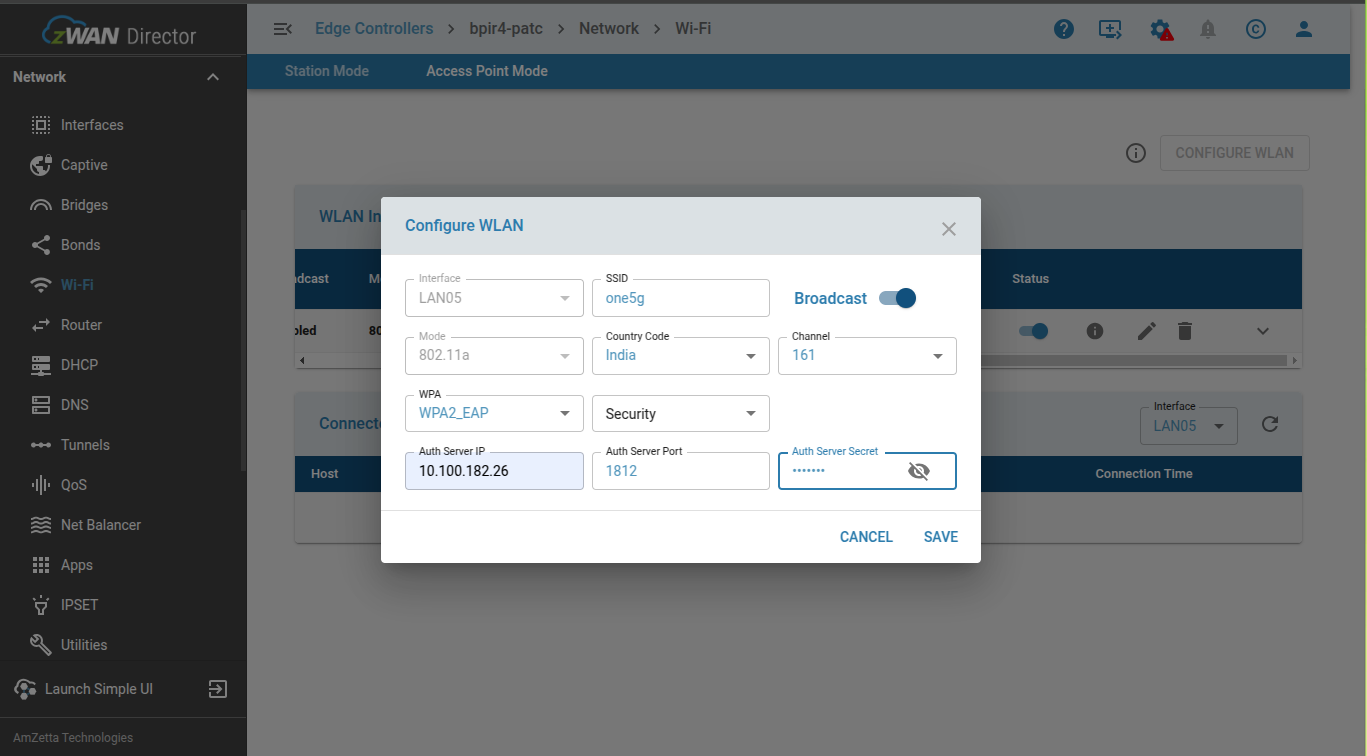
- The Auth Server IP is the FreeRADIUS server IP, the server port is the port on which FreeRADIUS is running, and the Auth Server Secret is the FreeRADIUS shared secret.
- WITHOUT PASSWORD
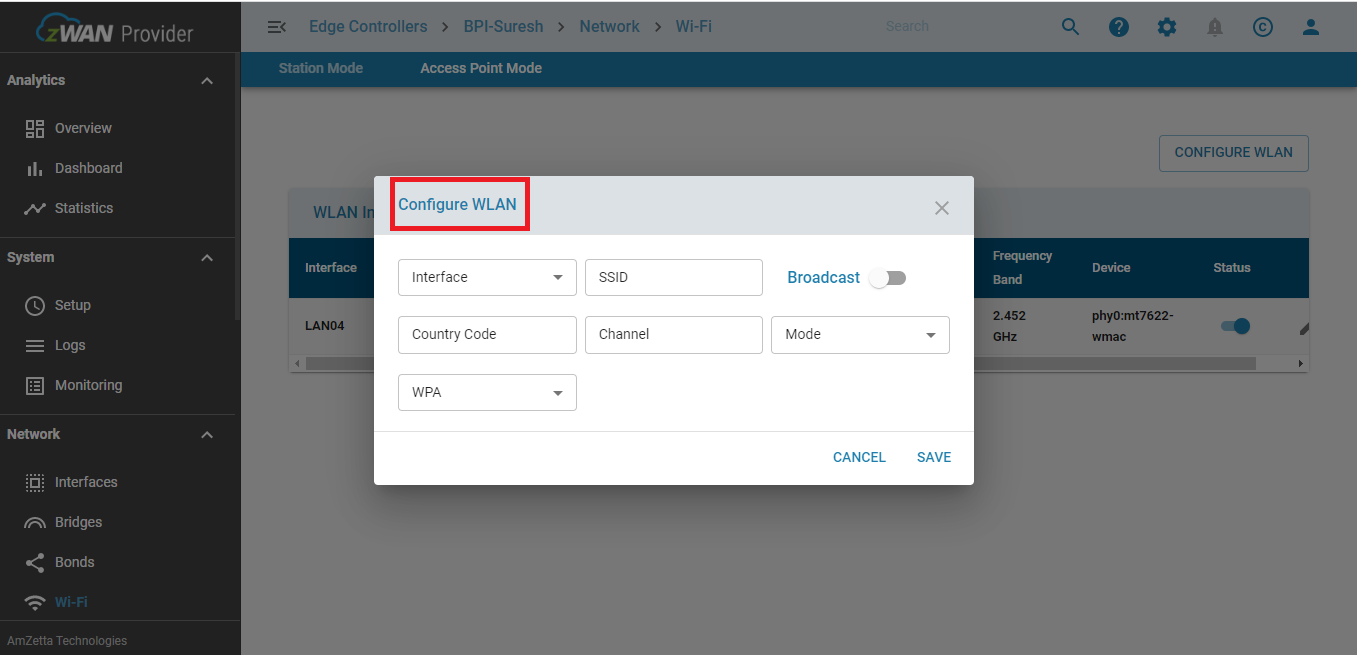
- We can configure Wi-Fi AP mode with/without password.
- For configuration of Wi-Fi AP mode we need to enter Interface name, SSID, broadcast/unicast type, Driver name, country code, WPA, Security and password .
Example
Enter the Wi-Fi Acces Point Interface Name : WLANxx
Enter the SSID of the Wi-Fi Network[max 32 Alpha char] : bpir64-acess-123
Enter the Broadcast/Unicast [0/1]: 0
Enter the Driver Name [802.11n] :
Enter the Mode [a/g] By default [g] :
Enter the Country Code [eg IN/US] : IN
Enter the Channel number [eg 1 upto 14 / auto] : 9
Enter the WPA [0/1/2/3] : 2
Enter the Security [TKIP/CCMP] : CCMP
Enter the Password [min 8 Char] : bpir64-acess-123
Enable Wi-Fi Access Point service
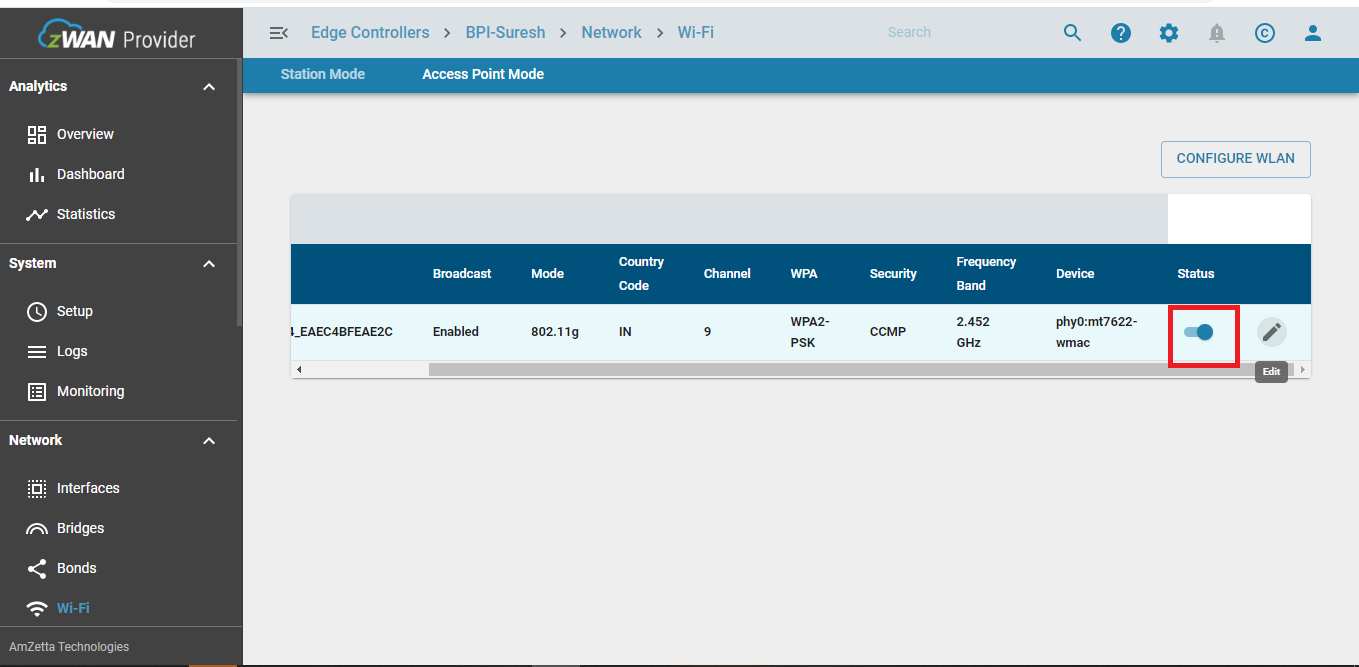
- Enable Wi-Fi Access Point service and the device will act as Access point(server)
Disable Wi-Fi Acces Point service
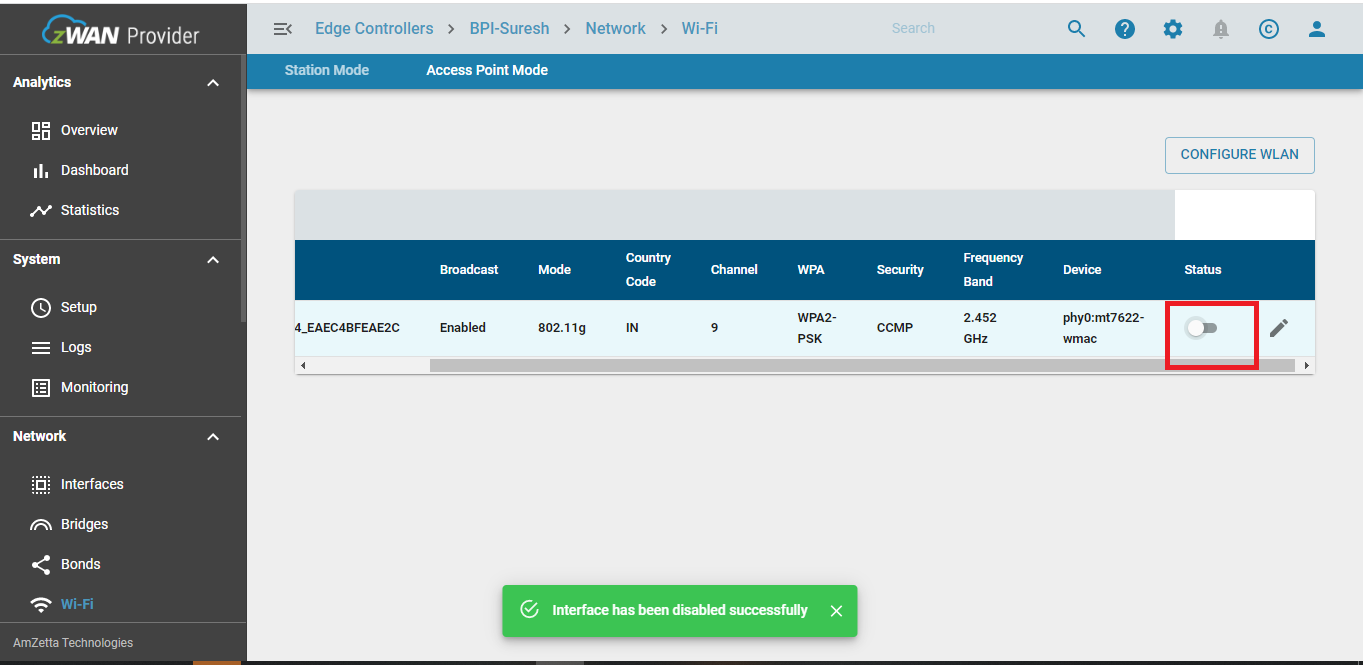
- Disable AP point service will stop device acting as Access point.
List Wi-Fi Acces Point Interface Configuration
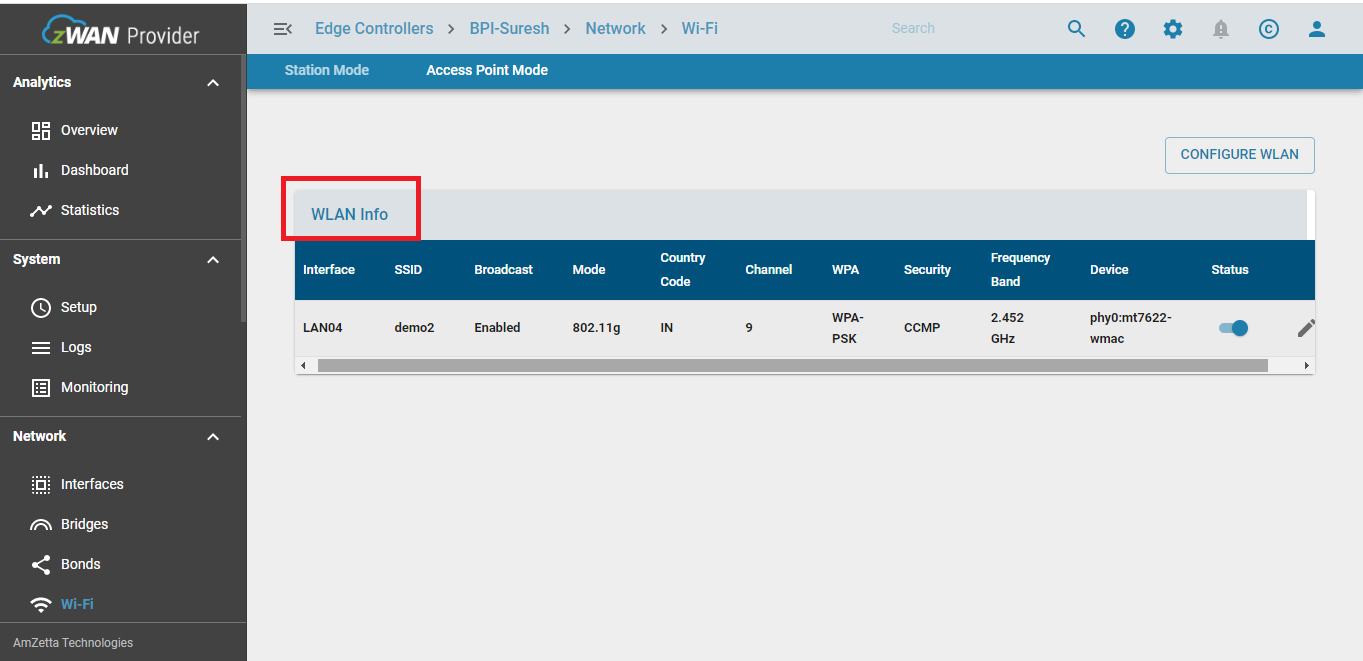
- We can list configured Wi-Fi AP mode details like interface name, ssid, security, driver details, broadcast details, frequency, state, security and channel.
Edit Wi-Fi Acces Point Interface Configuration
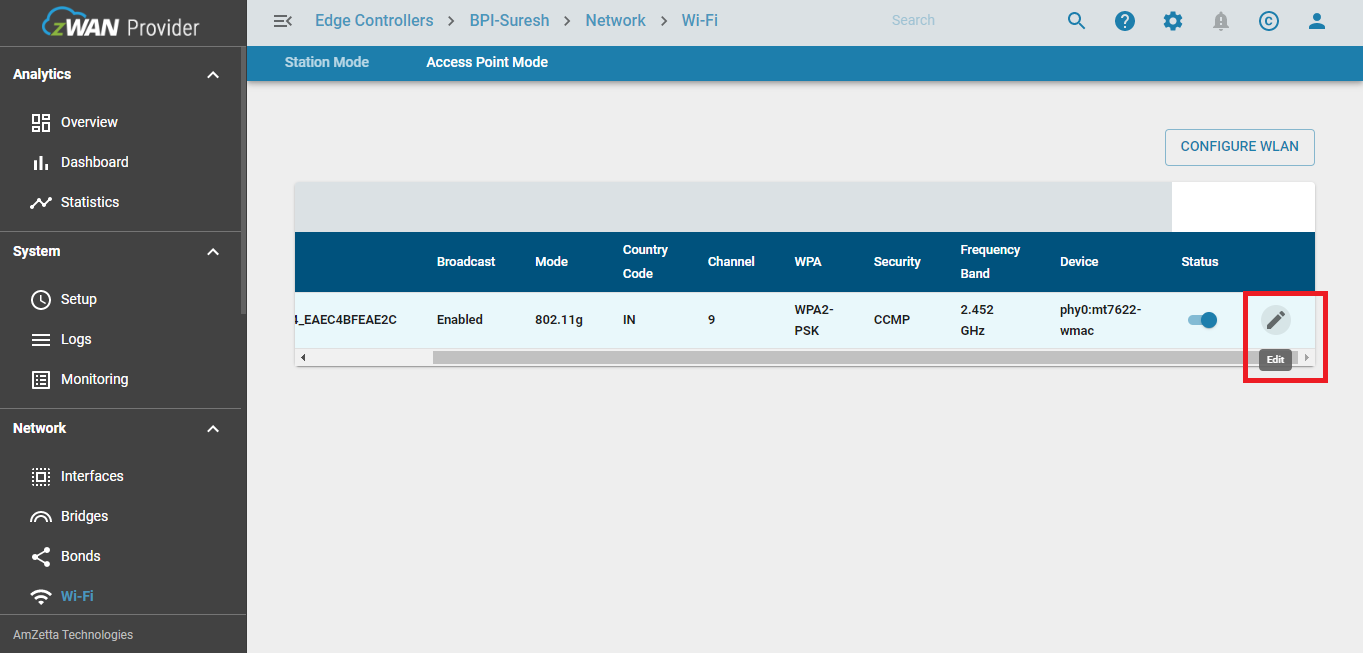
- We can edit configured Wi-Fi AP mode details like interface name, ssid, security, driver details, broadcast details, frequency, state, security and channel.
CONFIGURE Multiple SSID
- WITH PASSWORD
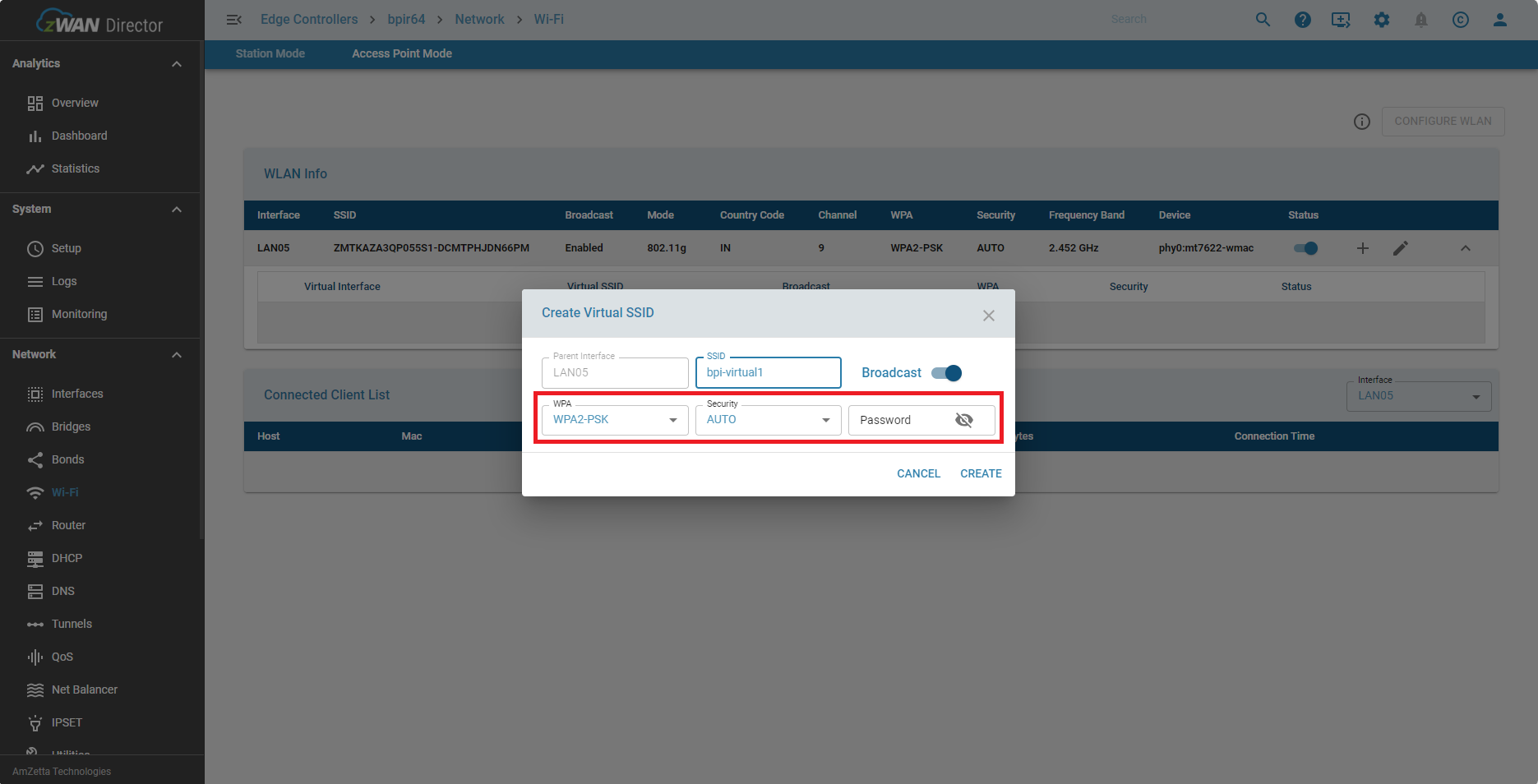
- WITHOUT PASSWORD
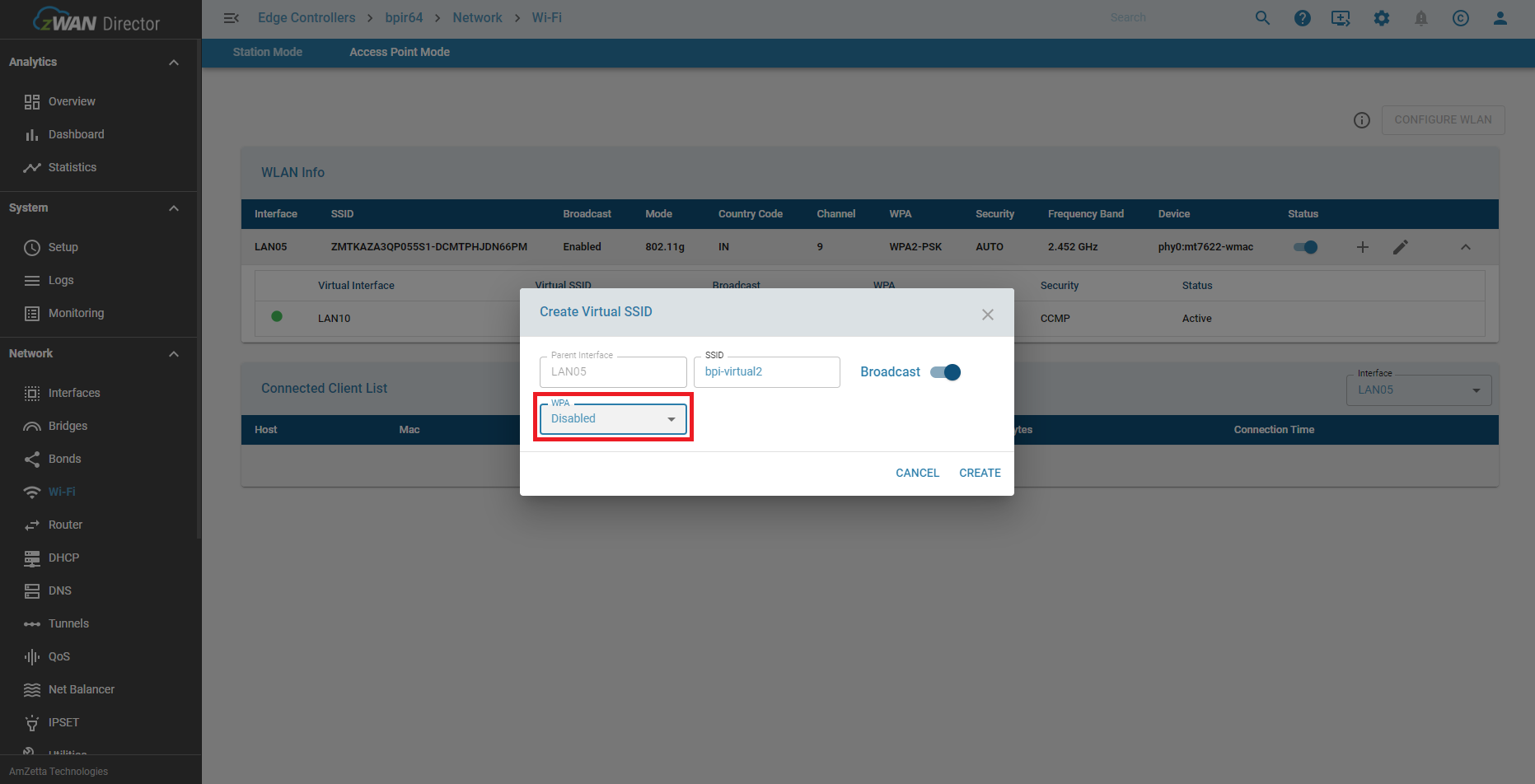
- We can configure Multiple SSID with/without password.
- For configuration of Multiple SSID we need to enter SSID, broadcast/unicast type, WPA, Security and password .
Example
Enter the SSID of the Wi-Fi Network[max 32 Alpha char] : bpi-virtual1
Enter the Broadcast/Unicast [0/1]: 0
Enter the WPA [0/1/2/3] : 2
Enter the Security [TKIP/CCMP/AUTO] : AUTO
Enter the Password [min 8 Char] : bpi-acess-123
Enable Wi-Fi Multiple SSID interface
- Enable interface device will act as virtual Wi-Fi( virtual server)
Disable Multiple SSID interface
- Disable interface will stop device acting as virtual Wi-Fi.
List Multiple SSID Interface Configuration
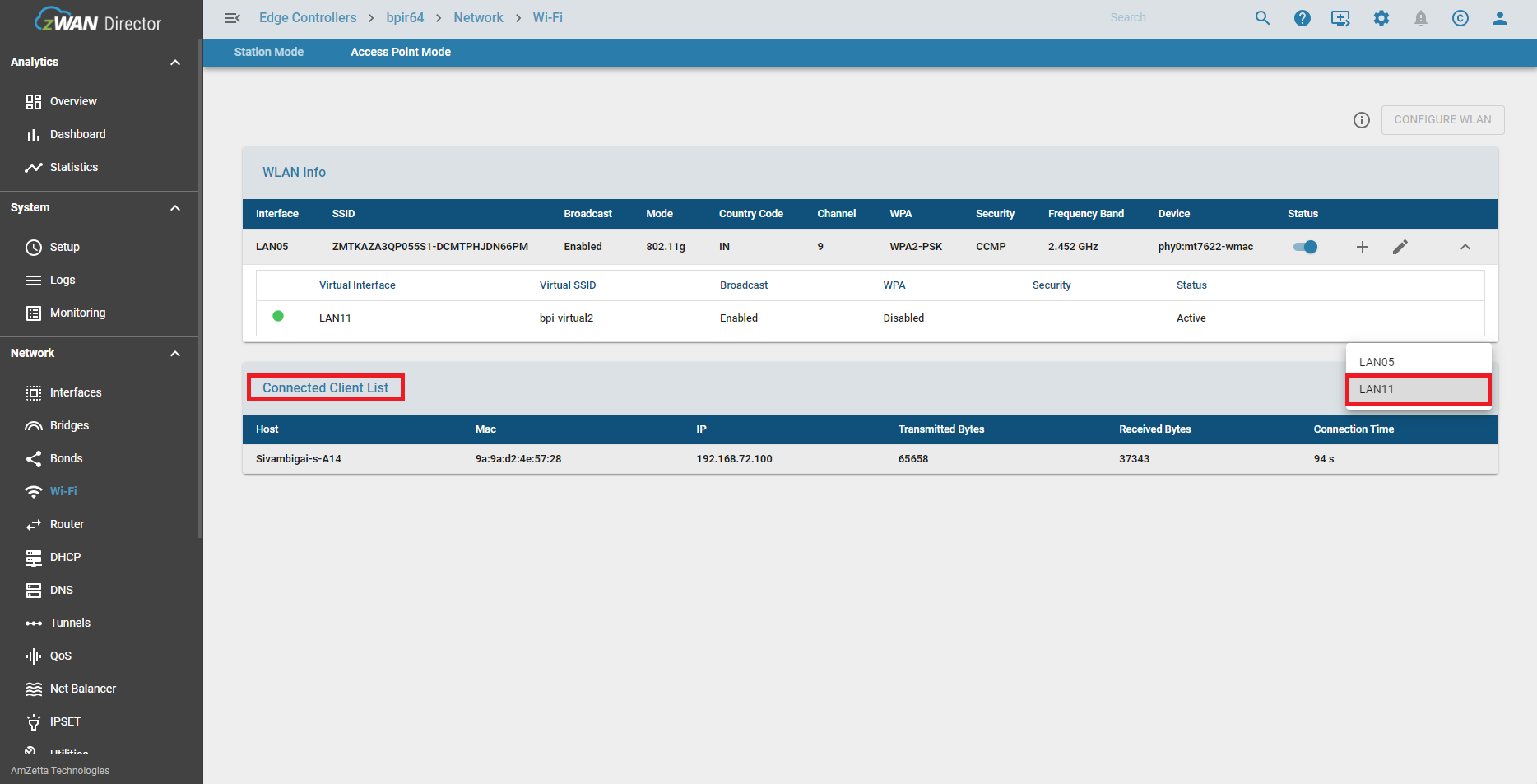
- We can list configured multiple SSID details like virtual interface, virtual ssid, status, security and broadcast details.
Edit Multiple SSID Interface Configuration
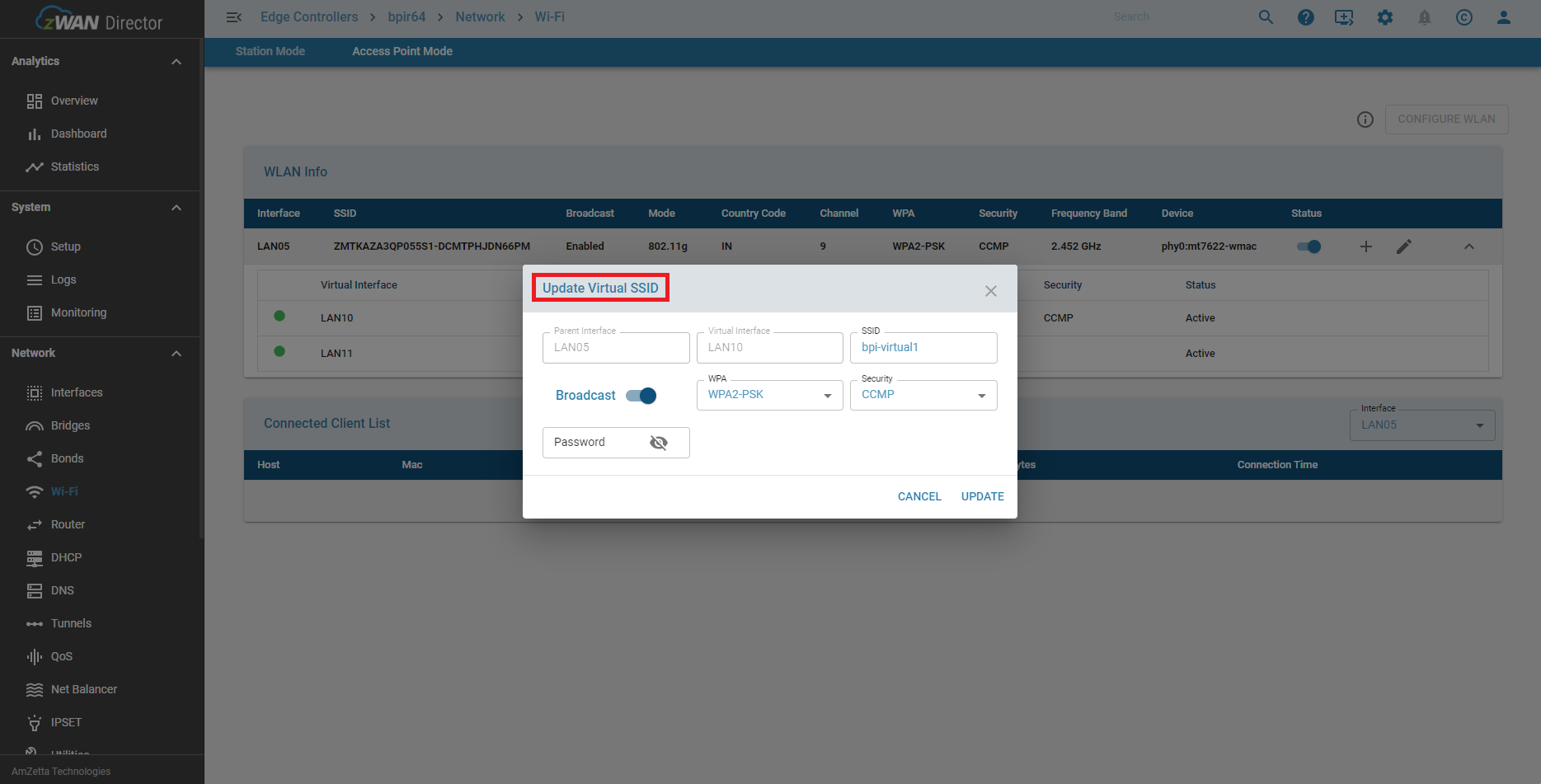
- We can edit Multiple SSID details like ssid, security and broadcast details.
Note:
- The Multiple SSID feature does not have a dedicated interface. It operates as a sub-interface of the WLAN interface.
- The properties [Country code, Channel, Mode] are applicable only to the Wi-Fi Access Point interface.
- In Multiple SSID, the properties [Country code, Channel, Mode] are common for all SSIDs and cannot be individually set, as they are based on the dedicated interface.
KNOWN HARDWARE LIMITATIONS - MT7622 SOC -802.11agn 2.4 GHz channels (1- 11/14)
- If AP mode enabled on a particular frequency channel and Station mode wants to connect to a particular Wi-Fi network with different frequency channel, this hardware does not support such combination, both AP and Station mode should work on same channel all the time. To work around this limitation, whenever stations mode configure/connect API is called, AP mode is temporarily stopped and restarted with same channel selected by the Station.