
-
SnapOS
-
-
- Articles coming soon
-
-
-
- Citrix HDX + USB Headset (Call-Center Baseline)
- OS/Firmware Update & Rollback
- Power Management and Session State
- Wi-Fi Roaming & Link Change Mid-Session
- Kiosk / Assigned-Access Auto-Launch
- Barcode Scanner (HID) with Line-of-Business App
- Printing to Local USB & Network Printers
- USB Device Management – Block Storage
- Multi-Monitor & 4K Performance
- Microsoft AVD/RDP + Teams Optimized Video
- VMware Horizon + Smart Card / CAC Login
-
-
-
-
zWAN
-
-
-
-
- Firewall & Layer 7 Application Filtering
- VPN Site-to-Site Tunnel Setup & Connectivity (z40 to Cloud vGR)
- Intrusion Prevention System (IPS) / Intrusion Detection System (IDS) Testing
- DNS Filtering
- DDoS Protection & Logging
- MAC Address Filtering & Geo-fencing
- Application Control & Protocol Blocking
- Authentication & Access Control (zID)
-
- WAN Link Failover & Load Balancing (ACI Mode)
- Dynamic Path Selection & Application-Aware Routing
- SaaS & Internet Breakout Validation
- QoS for Microsoft Teams (Datacenter vGR + Branch z40)
- Tunnel Failover (z40 ↔ vGR) — WAN00 (wired) primary, WAN03 (4G) & WAN04 (5G) backups
- IP Routing & Static Route Steering (z40 Branch)
- VLAN & Layer-2 Bridging
-
-
-
-
-
-
- Articles coming soon
-
-
-
-
- Articles coming soon
-
- Articles coming soon
-
-
-
-
-
-
- Articles coming soon
-
- Articles coming soon
-
- Articles coming soon
-
- Articles coming soon
-
-
-
-
-
- Articles coming soon
-
- Articles coming soon
-
- Articles coming soon
-
- Articles coming soon
-
-
-
-
-
- Articles coming soon
-
- Articles coming soon
-
- Articles coming soon
-
- Articles coming soon
-
-
- Articles coming soon
-
- IPsec Tunnel not Establishing
- SSL-VPN Tunnel not Establishing
- Mobile Network Issues
- Management Tunnel does not Establish
- DNS not Resolving from Local Network Appliance
- DNS Resolution Issues in Tunnel Configuration
- DHCP Server not Leasing IP to LAN PC
- Debugging EC Events - Unknown Status Issue
- Trusted-MAC Geofencing Issues
- DNS Issues from DC LAN PC
- Troubleshooting LAN Connectivity to Internet via WAN, Remote Branch LAN, or Local Branch LAN
- NetBalancer gateways displaying Faulty/Inactive
- Packet Drop Issues
-
-
zAccess
-
StorTrends
Classifier (QoS)
QoS Rule
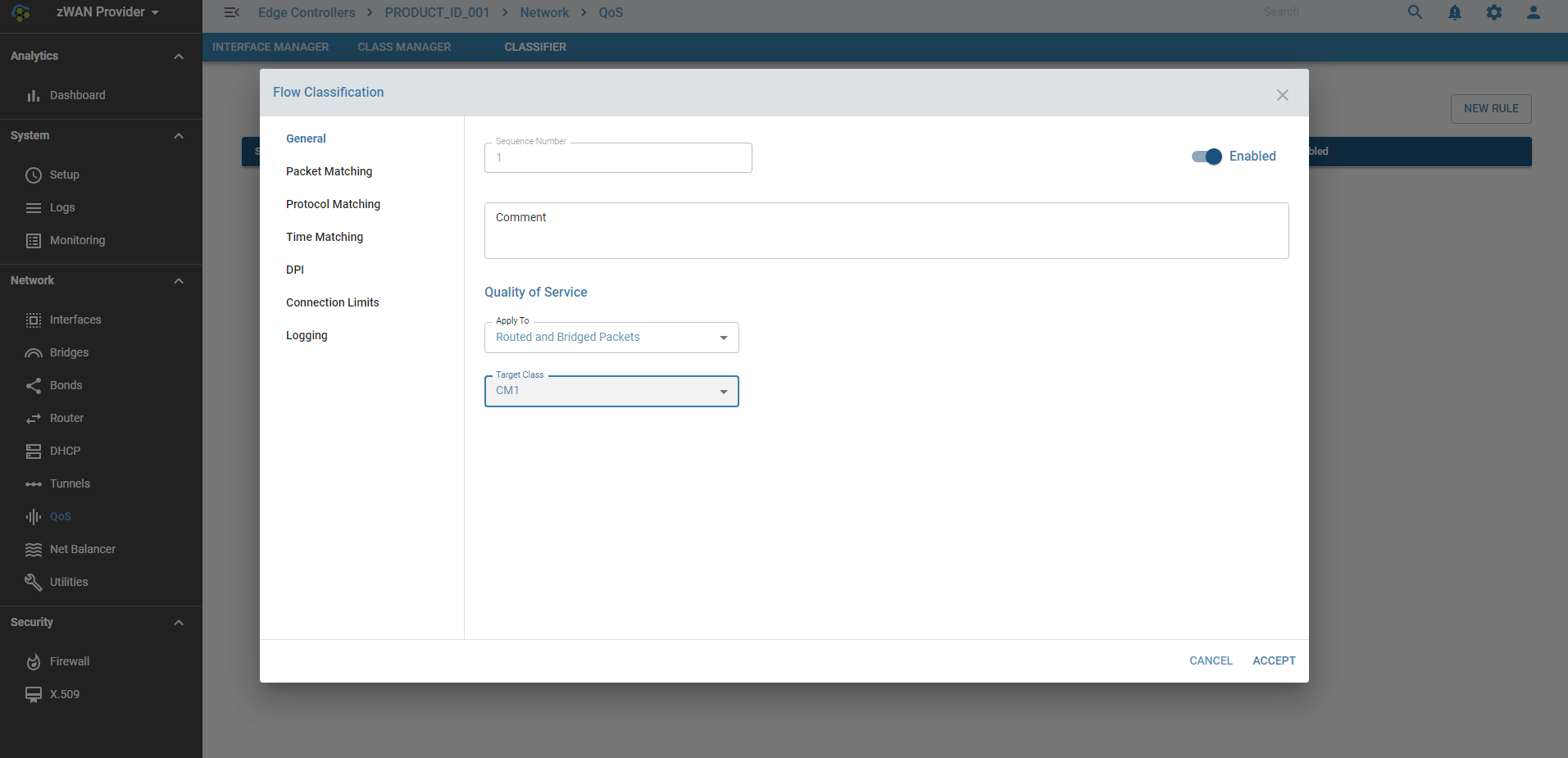
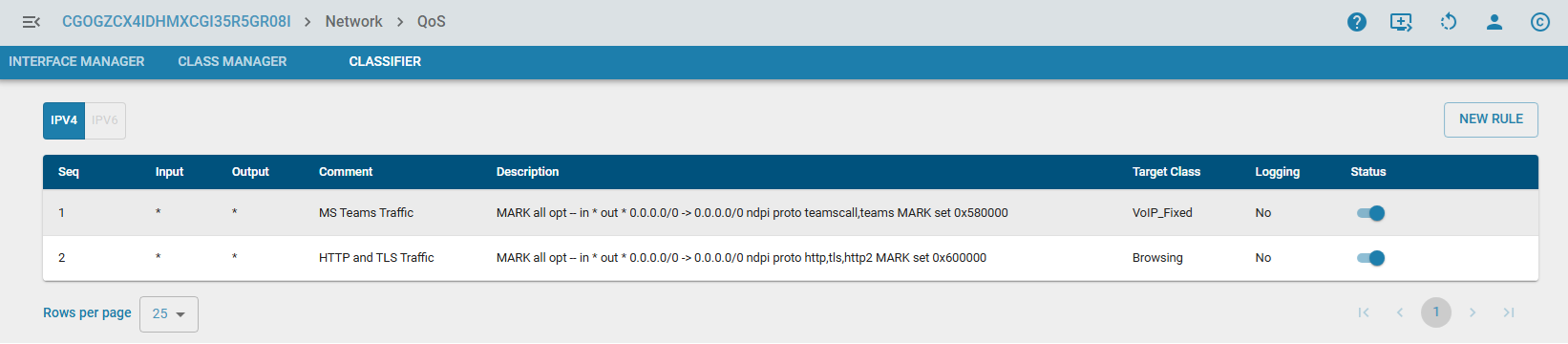
Refer to the Flow Classification section for creating rules. You must set a QoS Class [created in QoS Class Manager] as the Target for the rule.
Configuration steps
Step 1: Create Class Managers
Define your traffic classes under the Class Manager menu.
- Name: Give the class a short name (e.g.,
VoIP_Fixed,General_Web). - Descrition: Give the class description (e.g.,
VoIP Traffic with Fixed Bandwidth). - Priority & DSCP: Select the traffic Priority level and optional DSCP tag.
- Allocation Type: Select Bandwidth for critical apps or Percentage for general data.
- Limits: Set your Guaranteed and Maximum values.
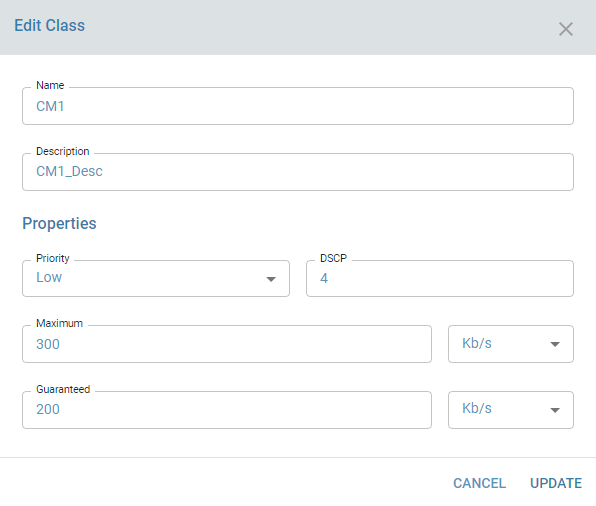
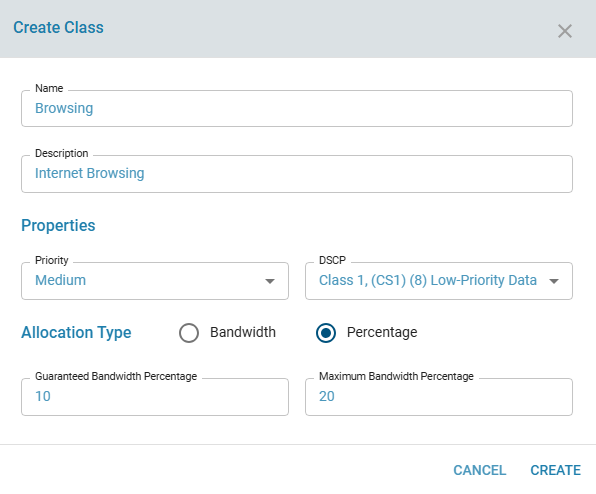
- All the created classes will be listed in QoS Class Manager
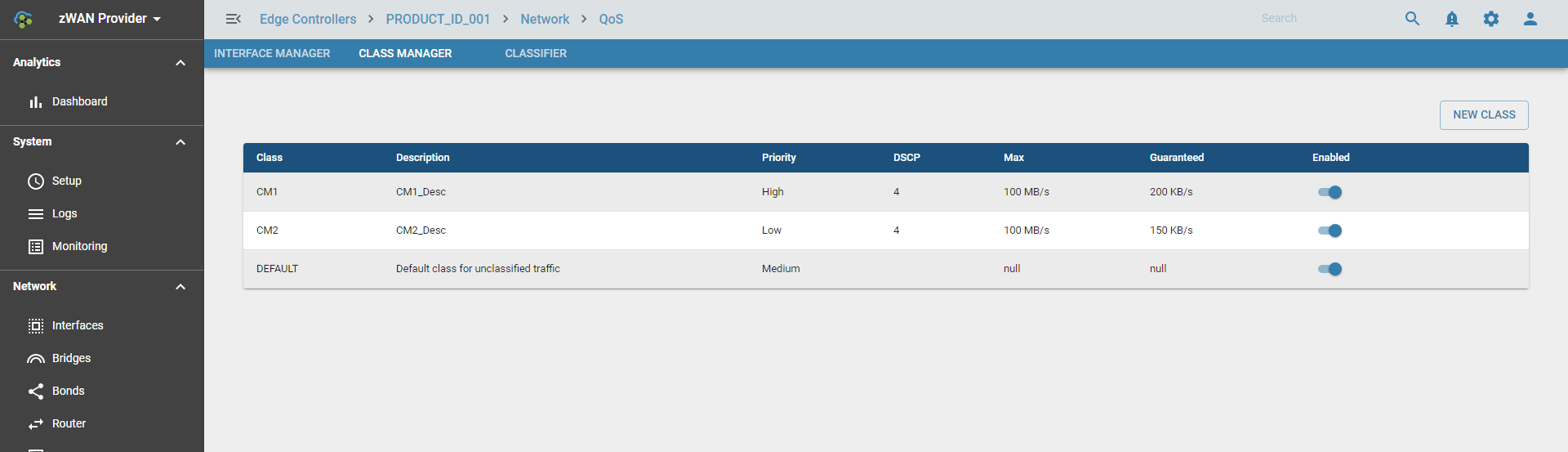
Step 2: Define Flow Classification Rules
Define one or more Flow Classification Rule for each QoS Class [i.e., Link traffic types to your Classes.]
- Create a Flow Classification Rule.
- Define the match criteria (
Source/Dest IP, Port, Application, DSCP). - Target: Select the Class Manager created in Step 1.
Step 3: Assign Classes to Interface
Assign one or more QoS Classes to an Interface (under Interface Manager)
- Select the physical interface.
- Add the Class Managers you wish to active on this port.
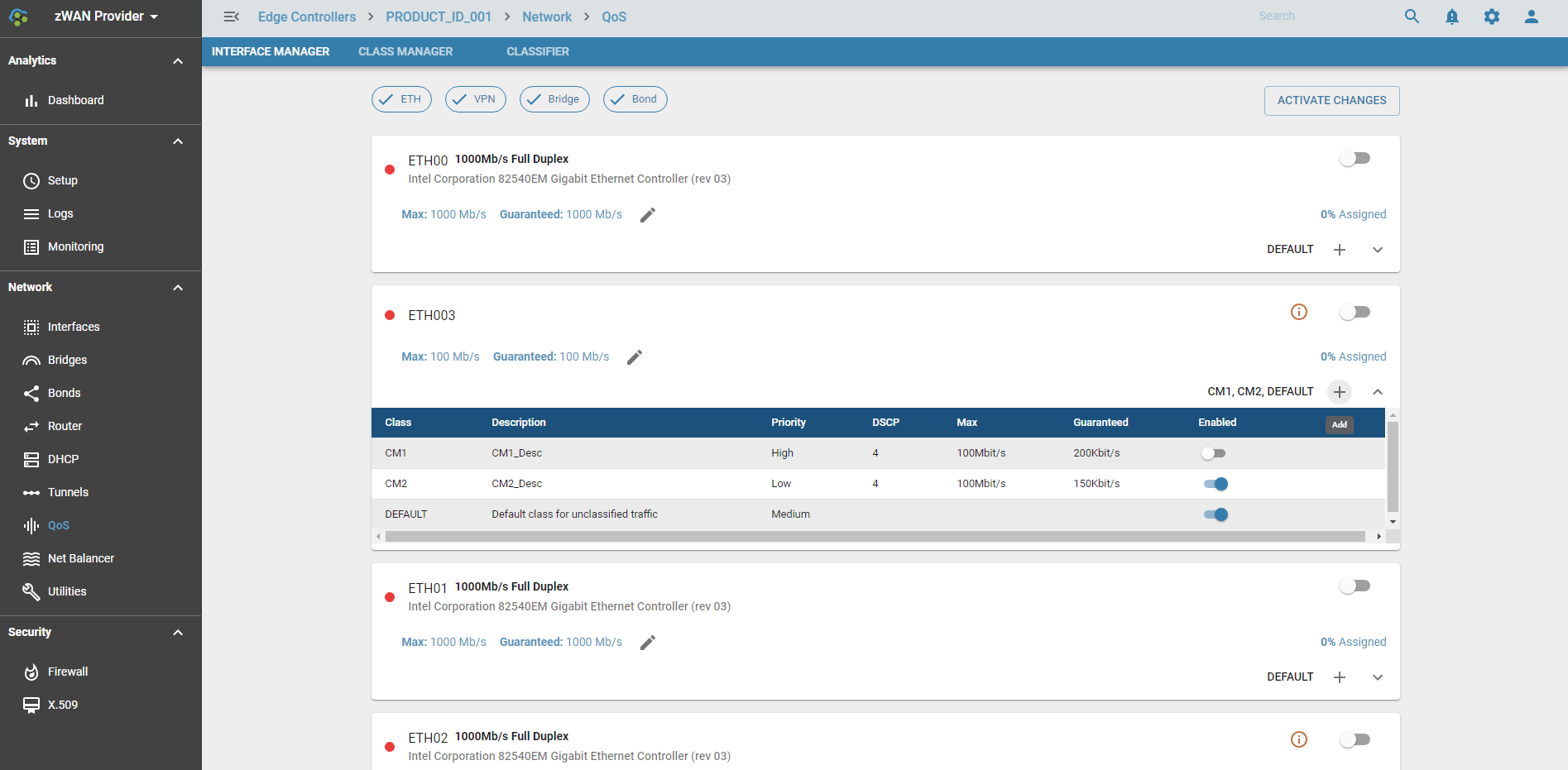
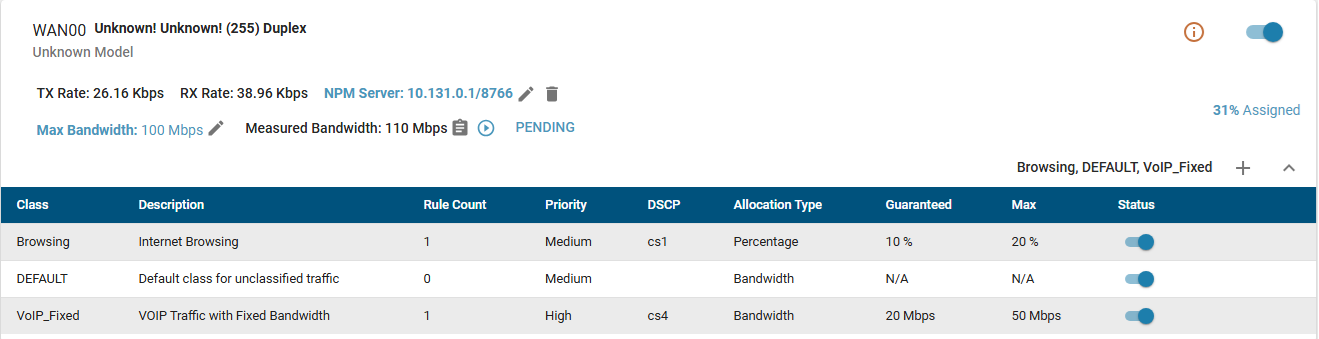
- List the classes that are assigned to the interface.
- Local Overrides (Interface-Specific Settings): Once a Class is added to an interface, its parameters (Bandwidth, Priority, Allocation Type) can be modified directly in this list.
- Scope: These changes are local to this interface only. They do not alter the original "Global" Class Manager definition.
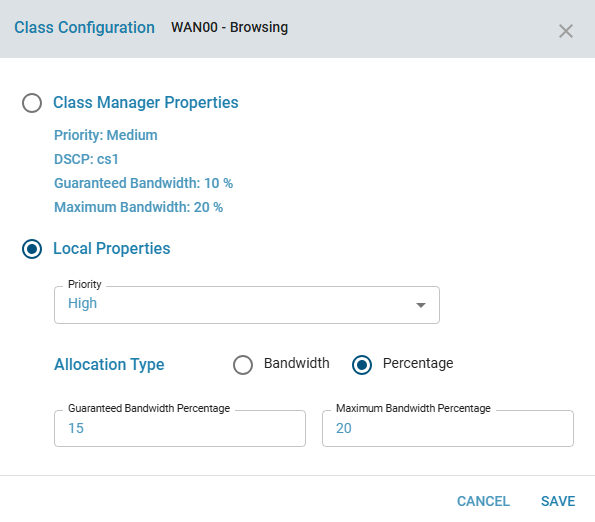
- Exception: DSCP Marking cannot be overridden locally. It is strictly inherited from the global Class Manager configuration.
- Activate the changes. The
iicon indicates activation is required.
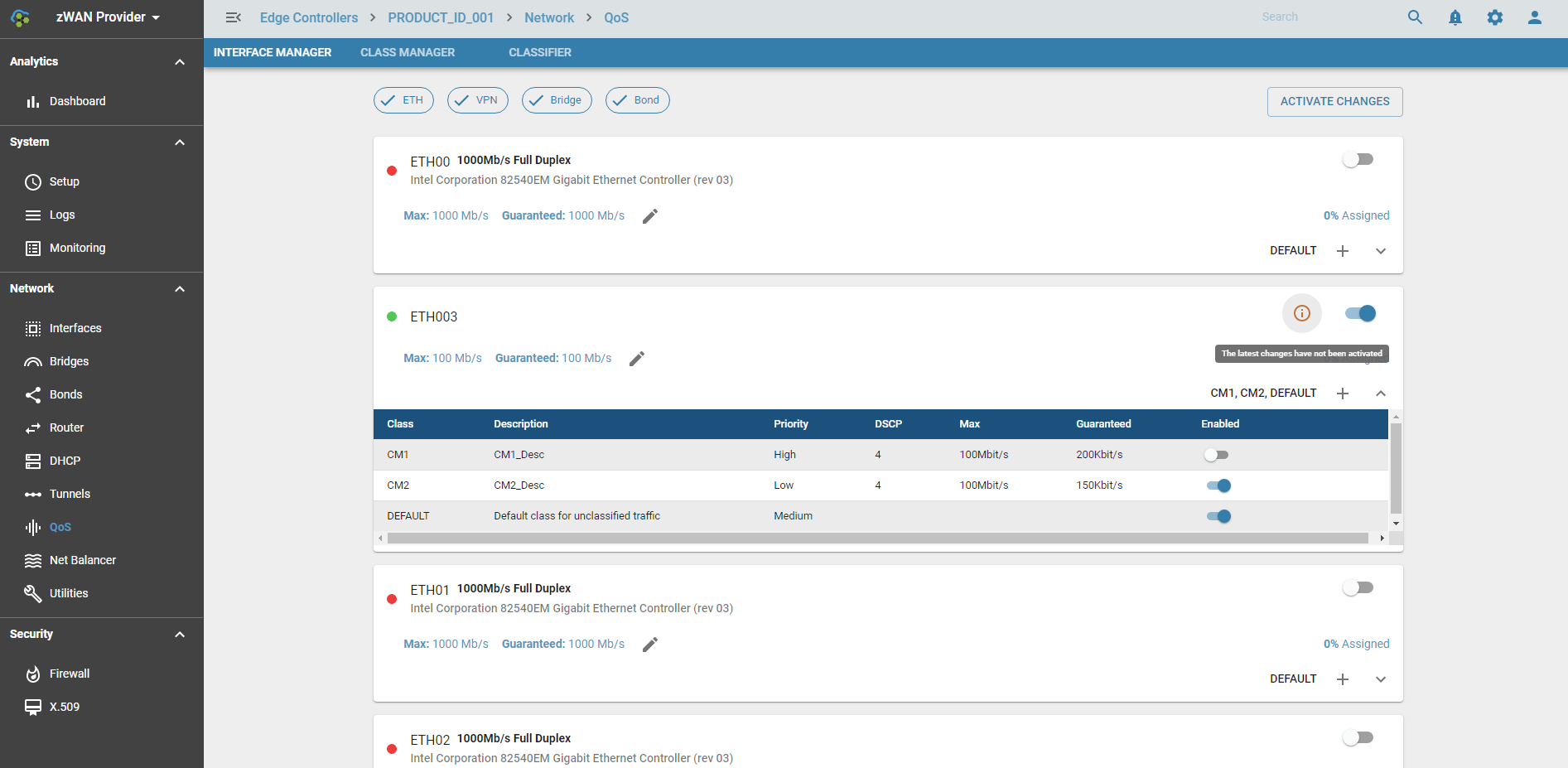
Once activated, the bandwidth allocation logic is applied immediately.
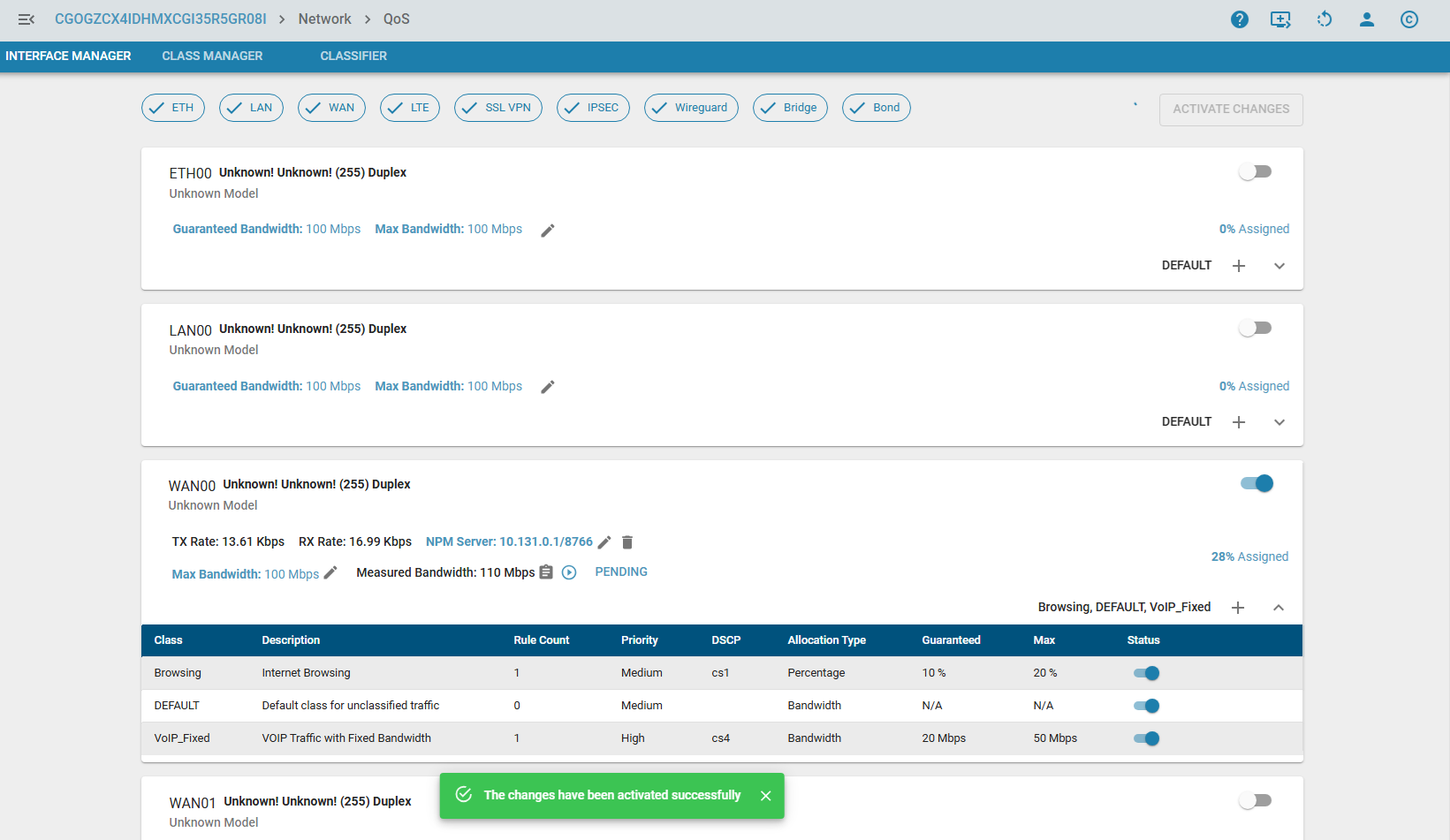
- Enable/Disable QoS globally for the interface.
Or Individual QoS classes also can be enabled or disabled.
Step 4: Set Interface Capabilities & Bandwidth
The Maximum Bandwidth for an interface acts as the ceiling for all QoS calculations. This value is determined in one of three ways, prioritized in the following order:
- Dynamic Measurement (NPM): If configured on a WAN interface, the actual measured throughput (
via active speed testing) overrides all other values.

- Manual Configuration: The user explicitly sets the Maximum/Guaranteed Bandwidth in the Interface Manager.
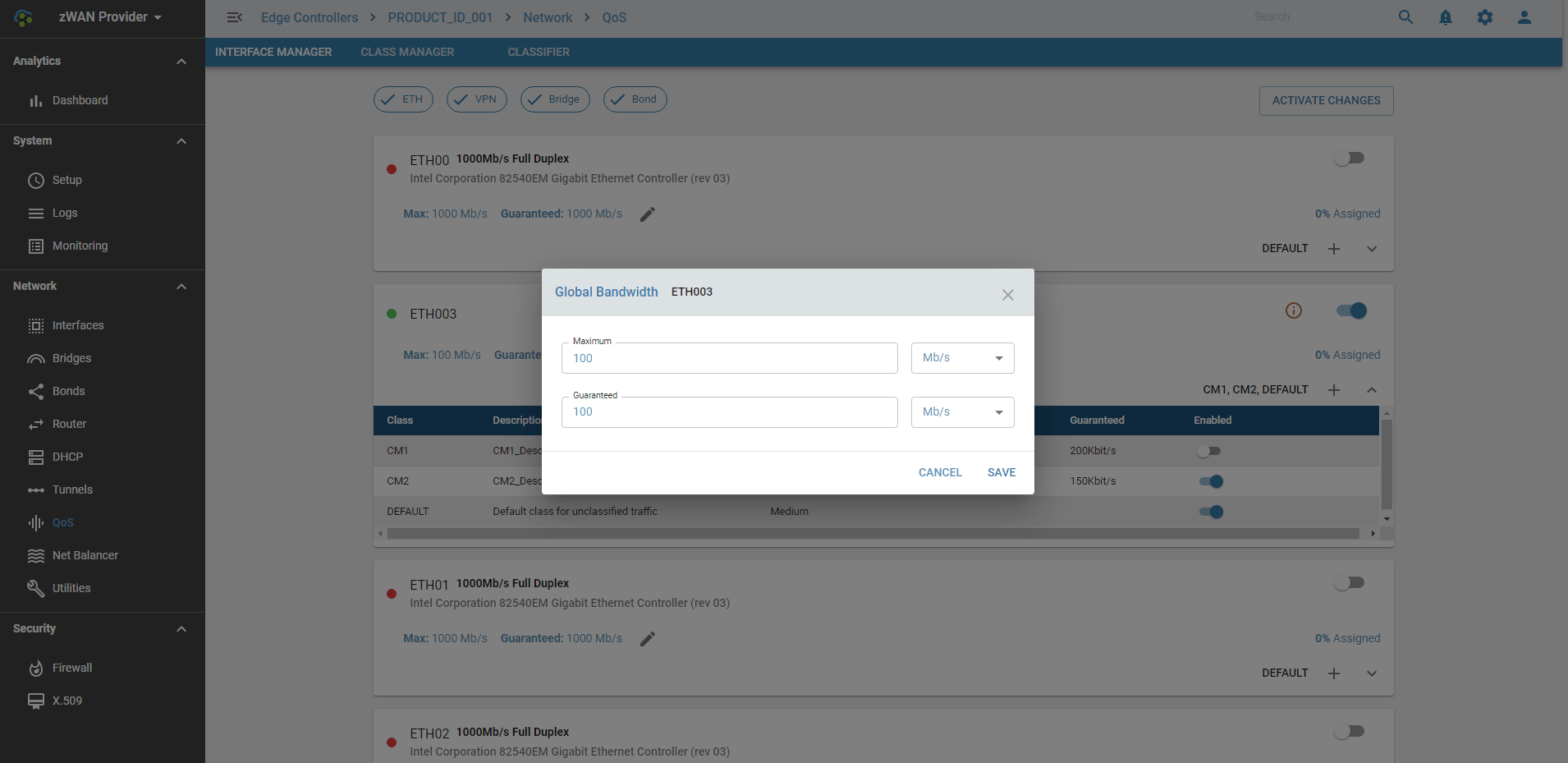
- Auto-Detection (Ethtool): During system bring-up, the OS detects the negotiated link speed (
e.g., 1000Mbps or 100Mbps).
Note: Make sure all the Bandwidth specified in QoS Class manager is within the limit of an Interface.
Step 5: Configure Network Performance Monitor (NPM)
For WAN interfaces, NPM can be enabled to dynamically measure Bandwidth, Packet Loss, Jitter, and Latency. NPM generates synthetic TCP and UDP load on Port 5206 against a target server.
Prerequisites:
Internet BreakoutMust be configured on the specific WAN interface to ensure the measurement traffic flows correctly through the Gateway.
Configuration Parameters:
- Measure Interval: How often the test runs. Default is 12 Hours. Can be customized.
- Remote Server: The IP address of the target NPM Server.
- Remote Port: The port the server listens on for control commands.
Default is 8766. (Note: The actual data test runs on port 5206).
Firewall Note: If the remote NPM Server is behind a router/NAT, you must forward Ports 8766 (Control) and 5206 (Data) to the server.
- Enable/Disable: Toggle to activate the feature.
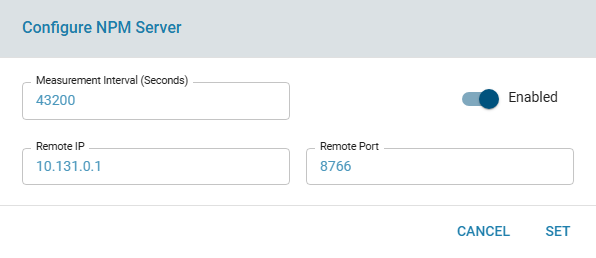
NPM States & Operations: On-Demand test can manually triggered by clicking the Play/Run icon.

The status indicator will show:
- PENDING: Waiting for the next scheduled interval or manual trigger.
- NOT READY: Interface is down, NPM is disabled, or current link usage is >50% (tests are
skipped to avoid disrupting user traffic). - RUNNING: Speed test is in progress.
- FAILED: Test failed (e.g., server unreachable).
- SUCCESS: Measurement completed.
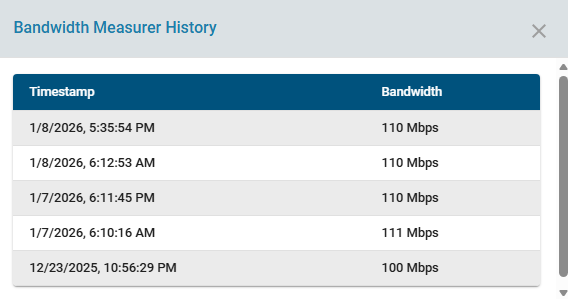
History: Click the Book icon next to the bandwidth value to view historical performance data.
Utility: CPE as NPM Server
A zWAN CPE can act as an NPM Server for other devices.
- Navigate to:
Network --> Utilities --> N/W Perf Monitor - Action:
Enable to Start NPM Server.

Note:
NPM Server/Client Mutuality:If a CPE is running as an NPM Server, it cannot simultaneously be an NPM Client. The NPM configuration options in the Interface Manager page will be disabled.Usage
QoS Class manager is used for Traffic Shaping. Packet belong to particular QoS class can take more precedence and get guaranteed bandwidth when the Interface has more packets to process. QoS class manager helps the Traffic Shaping module to sort the collision and prioritize the packet processing based on priority and bandwidth specified in QoS Class manager.
Known Behaviors & Limitations
- Oversubscription: If the sum of all Fixed Bandwidth classes exceeds 90% of the Interface Max, the system will clamp (reduce) the bandwidth of the lowest priority fixed class to fit within the limit. A warning will be logged.
- Minimum Floor: To prevent calculation errors, the minimum allowed bandwidth for any class is 10 Kbps.
- Atomic Application: When applying QoS changes, the interface may drop packets for a fraction of a second. This is intentional (Atomic Drop) to prevent packet leakage while the kernel switches queuing disciplines.
- Percentage Calculation: "100%" in a Percentage Class means "100% of the Remaining Bandwidth," not 100% of the total Link.
Formula: Class Rate = (Total Link - Fixed Classes) * (Class %)
[/vc_column_text][/vc_column][/vc_row]